
When Usefulness Becomes Identity
My wife will occasionally joke that I am a “nonprofit nerd.”
She says I know all things nonprofit — governance, finance, systems, ministry operations, organizational structure. Usually I laugh it off or tell her she is exaggerating, but if I am honest, part of me enjoys hearing it more than I probably should.
I have spent nearly forty years helping ministries and nonprofits carry responsibility. It started when my local church purchased their first computer and needed help setting up an accounting system and mailing database. At the time, it felt like a major organizational shift. Over the years, that early experience grew into a career centered around solving problems, building systems, and helping organizations navigate complexity.
Somewhere along the way, usefulness stopped being merely something I offered and quietly became something I relied on.
Even my StrengthsFinder themes seem to orbit around contribution and usefulness: significance, individualization, focus, maximizer, futuristic. The irony of “focus” showing up prominently for someone with ADHD is not lost on me. But perhaps that tension explains more than I realized. Much of my adult life has involved building systems and structures that compensated for weaknesses while allowing strengths to flourish.
And in many ways, those systems served people well.
But they also reinforced something deeper.
Part of the struggle for many people with ADHD is the quiet sense that you are always trying to make up for something. You become aware early that your inconsistency, procrastination, distractibility, or intensity affects the people around you. Over time, usefulness can become a way of earning credibility. Excellence becomes a way of reassuring both yourself and others that you are capable, responsible, and dependable despite the places where you know you sometimes create frustration.
The work may genuinely help people. The competence may be real. But underneath it, there can also be a subtle fear that simply being yourself is not enough.
I do not think that dynamic is limited to ADHD.
Many leaders spend decades becoming extraordinarily useful. Organizations reward responsiveness. Ministries reward sacrifice. People naturally lean toward those who can solve problems and carry weight reliably. Over time, it becomes very easy for usefulness to drift from stewardship into identity.
And when that happens, slowing down can feel threatening in ways that are difficult to explain.
This year has already been a season of significant transition for me. I intentionally reduced some of the work I had been carrying for years and stepped away from several ongoing operational responsibilities. I knew those changes would have financial implications. What I did not fully anticipate was how much they would expose emotionally.
Then I got sick.
What I initially treated as an interruption became an extended recovery that forced me into a slower pace than I would normally choose. And in the stillness, God began exposing some deeper identity attachments that had remained mostly hidden beneath years of productivity and responsibility.
Recently, a guest speaker at our church made the statement, “The space between God’s promises and what we currently see is holy.” That line has stayed with me because I suspect many leaders live in that space more often than we admit.
Not simply between vision and fulfillment, but between who we have been and who God may now be asking us to become.
I have spent much of my life being useful. Some of that has been healthy stewardship. Some of it has been genuine calling. But this season has forced me to confront how much reassurance I still drew from being needed.
That realization has been uncomfortable.
But perhaps that discomfort is also part of the invitation.
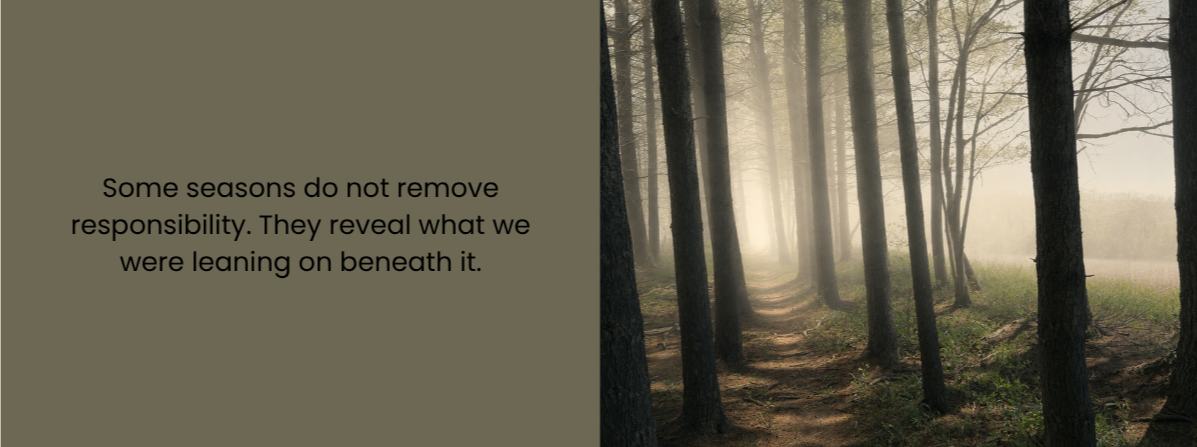
Sometimes God uses interruption not simply to change our pace, but to loosen identity anchors we did not realize we were carrying. Sometimes the wilderness is not punishment or delay. Sometimes it is preparation for a steadier identity — one less dependent on constant usefulness and more deeply rooted in His presence.
I am still walking through that process now.
Still learning how to become comfortable being uncomfortable. Still learning that usefulness can be a gift without becoming the foundation of worth.
If you would like to receive our newsletter Thoughts from the Trail every Tuesday, you can sign up using our MailChimp form.
