Don’t Interrupt the Shift

I needed the reminder.
So a big thanks goes out to Joshua Cole, who posted this recently:
You stepped back.
Things slowed down.
So you stepped back quickly.
That’s the mistake.
You interrupted the shift.
That last line has stuck with me because, if I am honest, I think I have been wrestling with the temptation to do exactly that.
A month ago, I stepped back. Not intentionally.
I knew this year was going to be a pivot year. My word for the year is uncomfortable — which honestly never feels encouraging at the beginning of a year. My verse for the year has been Isaiah 43:18–19.
I had already started making changes. I intentionally reduced some services I offered. I transitioned daily dependence on me to other people for my clients. In April, I turned sixty and handed off the last of the daily operational responsibilities I had still been carrying. I looked toward this season with expectation.
Then I got sick.
What I thought would be a short interruption became a slower-than-expected recovery that seemed to bring everything to a stop. At first, I treated the pause like a disruption — something to recover from quickly so I could move into the next stage. But over time, I started realizing the pause was not interrupting the transition.
The pause was the transition.
What I originally thought was simply illness became the place where the old rhythm finally stopped long enough for something deeper to surface. That has been more uncomfortable than I expected because most leaders know how to function inside momentum.
We know how to stay useful. We know how to stay needed. We know how to keep carrying responsibility.
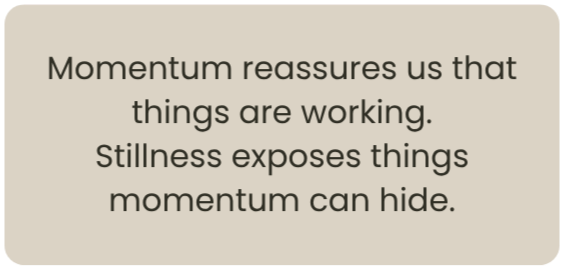
For me, the pause exposed how much of my identity is still connected to activity, responsiveness, and being continually needed. Not necessarily in unhealthy ways, but in familiar ones. After decades of leadership, I’ve become accustomed to movement, decisions, problems to solve, and people depending on me. When that suddenly slows down, it feels disorienting even when the slowdown is necessary.
Recently, guest speaker Rev. Amy Parsell preached about the beauty of tension. One line especially stayed with me:
The space between God’s promises and what we currently see is holy.
I think that was already working somewhere in the back of my mind when I read Joshua’s post because much of leadership is lived in that space — between calling and clarity, between transition and understanding, between what God has spoken and what we can currently measure.
Most of us want tension resolved quickly because we want reassurance that something is actually happening. We want visible movement, clear confirmation, something we can point to that explains the delay and makes the uncertainty feel worthwhile.
But God does not always remove the tension. Often, He meets us inside it.
I thought I was ready to move immediately into the next season. Instead, I sensed God reminding me to remain steadfast, to trust Him for daily bread, and to remember that the desert was never where He abandoned His people. It was where He prepared them.
That thought has stayed with me because we often interpret wilderness seasons as evidence that something has gone wrong. But throughout Scripture, wilderness seasons were frequently places where awareness deepened and dependence became clearer. Not anxious striving, but attentiveness. Presence.
Psalm 130 says:
“I wait for the Lord, my whole being waits,
and in His word I put my hope.”
— Psalm 130:5
The Hebrew idea behind “wait” carries tension inside it. Not passive resignation, but hopeful expectancy stretched between promise and visibility.
I think that describes many leadership seasons more honestly than certainty does, especially in transition. Especially when old roles are fading before new clarity has fully arrived.
Sometimes the hardest part of leadership transition is allowing an old operating identity to loosen its grip, particularly when that identity has served others well for a long time. Competence feels safe. Familiarity feels reassuring. Continuing what has always worked can feel difficult to release.
But faithful leadership also requires discernment about what should not be carried forward unchanged into the next season.
That does not mean the previous season was wrong. It simply means God does not form us through acceleration. He forms us through tension, stillness, and dependence.

I am sitting in that tension myself.
Still asking God for manna. Still learning how to become comfortable being uncomfortable. Still needing to recognize what feels like interruption may actually be preparation.
And perhaps one of the quiet disciplines of leadership is learning not to interrupt the shift before God finishes the work the tension came to do.
If these reflections resonate, Thoughts from the Trail (a weekly newsletter) offers a quieter space for more personal and formative reflections for nonprofit leaders navigating complexity, transition, and discernment.