Walking by Faith in Unfamiliar Territory

This week, I was reminded of something uncomfortable.
As leaders, we already know this: walking by faith is hard.
What’s easy is walking by our senses.
That’s what gets us into trouble.
Trusting what feels spiritual is not the same thing as walking by faith.
My spiral this week wasn’t significant.
Nothing blew up. Nothing crashed.
But I did lose focus—and in losing focus, I felt the beginning of a spiral.
I became so intent on implementing a new marketing plan that I shorted my spiritual disciplines. What I didn’t notice at first was the cost.
As those disciplines slipped, fear started to grow quietly in the background.
I can’t do this.
If I fail, how do we pay the bills?
This is crazy.
What if no one signs up for a discovery call?
Is this really me?
I didn’t label those thoughts or stop to examine them. But they began to create an internal spiraling—subtle, persistent, and distracting.
This insight didn’t come while I was thinking about my own week.
It came earlier that morning while Christine and I were praying for someone else.
We weren’t praying with them. We were praying for them—someone who is struggling to discern God’s direction and who, from the outside, appears to be spinning. They’re trying to make sense of what God is doing while everything feels unstable.
As we prayed, an image came to mind: a ballet dancer.
I was reminded—certainly not from personal experience—of the concept of spotting. A dancer fixes their eyes on a single point and, during each rotation, snaps their head back to that point to stay oriented and avoid dizziness.
The image helped inform how we prayed.
It wasn’t until later that I realized God was also speaking to me.
At first, the illustration felt straightforward.
The image spoke to the importance of staying focused on God’s purposes. In the normal turbulence of life, fixing our attention on Him can steady us and keep us from becoming disoriented.
We used the image as we prayed.
It felt right.
Helpful.
Complete.
That should have been the end of it.
But as the day went on, the image wouldn’t leave me alone.
By mid-afternoon, I realized why.
I had been spinning too.
Not dramatically. Not publicly. But enough to notice.
The discomfort I felt wasn’t coming from confusion about God’s direction. It was coming from stepping into something unfamiliar and realizing how quickly I had started relying on my senses instead of my disciplines.
As I kept thinking about the idea of spotting, a question surfaced:
Do pilots do something similar?
They don’t.
In fact, flying by sight—by feel, by bodily sense—is how really bad things happen. Pilots are rigorously trained to distrust their senses and trust their instruments instead.
That distinction stopped me.
Because what I had been experiencing all week wasn’t a lack of faith. It was the result of paying attention to my senses while neglecting the very instruments God has already given me.
Once that clicked, the question became obvious:
What are the instruments I’m supposed to trust?
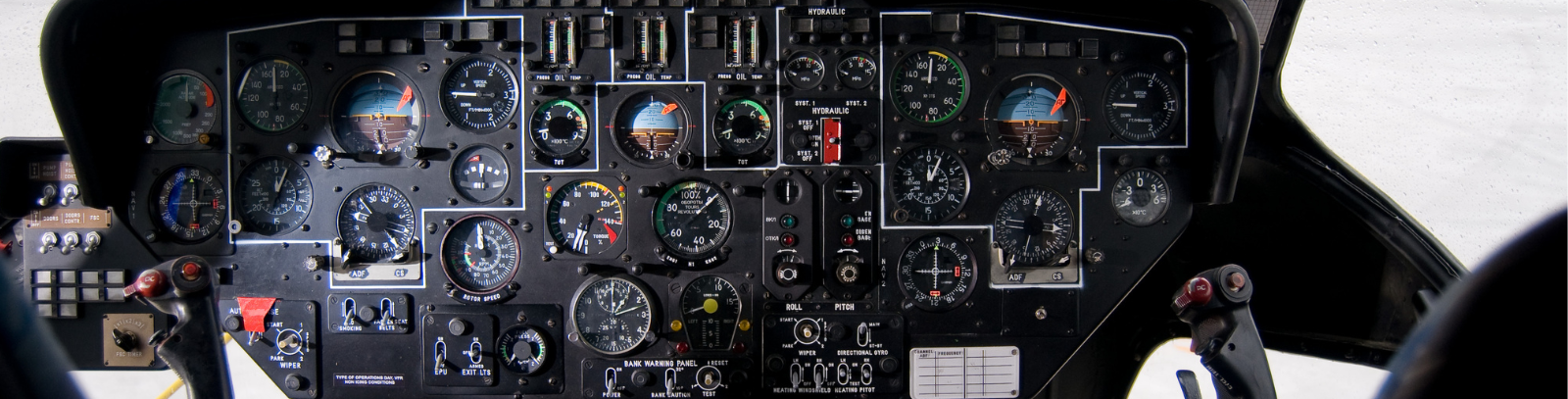
For pilots, the answer is clear. When disorientation sets in, they are trained to:
Freeze unnecessary movement
Level the wings using instruments
Establish known power and pitch
Maintain altitude and heading
Slow down thinking and speed up discipline
That last line stuck with me.
Because my problem this week wasn’t reckless action—it was overthinking. And the solution wasn’t more analysis. It was returning to the disciplines I already know.
Prayer.
Scripture.
Time with God.
Getting outside and walking.
Re-centering on the calling God has already made clear.
When I shorted those disciplines, fear filled the gap.
When I returned to them, orientation followed.
As Christian leaders, we’re often taught to walk by faith and not by sight.
But walking by faith does not mean trusting whatever feels spiritual in the moment.
Sometimes our senses—our emotions, our gut reactions, even our internal alarms—are responding to fear, not to God. And when we mistake that fear for discernment, we begin to drift.
Walking by faith means distrusting my senses when they conflict with what God has already made clear. It means returning to the instruments He has given me—His Word, prayer, calling, and discipline—especially when obedience feels unfamiliar.
This week reminded me that my spiral wasn’t spiritual insight. It was anxiety triggered by doing something new.
And the way out wasn’t clarity through more thinking.
It was orientation through discipline.
If you’re stepping into unfamiliar territory right now—new responsibility, new expectations, or a new season—it may be worth asking a simple question:
Am I walking by faith, or am I reacting to what my senses are telling me?
If fear has started to grow, it doesn’t necessarily mean you’re off course. It may simply mean you’ve drifted from the instruments that keep you oriented.
Slow down the thinking.
Speed up the disciplines.
And trust that God is no less faithful in the unfamiliar than He was in the familiar.