When Being Under Budget is Bad News
IN THIS ISSUE
Why spending less can undermine an organization’s strategy
What happens when leaders miss the urgency behind the budget
Why approving a strategic budget is not enough
OPENING REFLECTION
I remember reviewing the results of an organization that had approved an aggressive marketing budget. The purpose was clear: generate enough demand to increase the number of people served and produce the related program revenue.
Marketing spent less than half of its budget. Leaders celebrated the savings, but the intended work had not happened. Services declined by 5 percent. Revenue fell short. The organization ended the year with a serious operating deficit.
The following year began with fewer resources, making those marketing dollars even harder to provide. Still, the organization again made the sacrifice and funded the strategy. And again, the department spent only half its budget.
Leaders were pleased with the expense savings while remaining dismayed by declining services, lower revenue, and another deficit.
At that point, this was no longer simply a budgeting problem. It was a leadership problem. The board had approved the strategic direction, but the organization’s leaders had not grasped—or acted upon—the urgency behind it.
WISE STEWARDSHIP IS NOT ALWAYS SPENDING LESS
Stewardship requires leaders to understand why resources have been entrusted to the organization and to use them accordingly. It cannot be measured simply by how much money remains unspent.
Sometimes wisdom requires holding resources back. At other times, it requires spending money on work that leaders have already determined is necessary. In this case, the expense savings were more than offset by fewer services and lower revenue. What appeared wise within one department weakened the organization as a whole.
Wise stewardship asks a broader question than, “Did we spend less than budget?”
It asks, “Did we use the resources entrusted to us to accomplish what we believed mattered?”
A BUDGET DOES NOT IMPLEMENT ITSELF
A budget can reflect the right strategy and still fail to move the organization forward.
In this case, the board had approved the direction and provided the resources. A core leader had participated in developing the budget. Yet coming in under budget was still treated as an accomplishment, without considering why the money had been allocated or what the underspending would mean for the rest of the organization.
The first year could have been dismissed as a departmental execution problem. The second year revealed something larger. The organization had not translated its strategy into clear expectations, ongoing monitoring, and leadership accountability.
A strategic budget should connect three things:
What the organization intends to accomplish
What activities and resources are required
What financial and operating results will show whether the plan is working
Those connections must remain visible throughout the year.
A favorable expense variance should have prompted questions while there was still time to act: Why is marketing spending so far behind the plan? Are the intended activities taking place? Is demand developing as expected? What will this mean for service volume and revenue?
Instead, leaders reviewed the expense savings separately from the decline in services and revenue. They celebrated one result and were dismayed by the others, even though all three were connected.
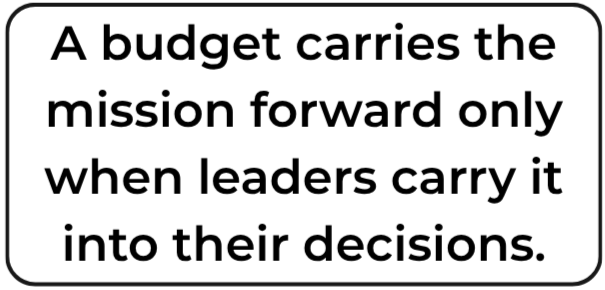
A budget is more than a spreadsheet. Done correctly, it is the financial expression of the organization’s strategy. But approving the budget only establishes direction. Its power comes when leaders understand it, use it to guide decisions, and respond when implementation begins to depart from the plan.
NEW RESOURCE
Use the Purpose-Driven Budget Rubric to evaluate whether your organization’s budget clearly reflects its mission and priorities:
https://www.breakthroughcoaching.life/s/Breakthrough-Coaching-Budget-Rubric-v2026.pdf
INVITATION
Learn more about the Mission-Based Budgeting workshop:
https://www.breakthroughcoaching.life/mission-based-budgeting